If you see mouse droppings, or a mouse, it is time to take action: Trap, Block, & Clean Up.
Trap: Set up traps inside. If you are uncertain where your mice may be, focus on warm areas, like under the refrigerator where the compressor keeps the area warm.
Block: Try to block mice from getting in. This may be a huge task in some New England homes, especially those with older foundations, stone foundations, or porches and decks you cannot get under. Your foundation is your frontline. Filling mouse holes is like filling pot holes, it should be done regularly because rodents will make new openings and the expansion and contraction of buildings in the northeast climate can create openings, particularly where wood and cement or concrete meet (the foundation) or around door seals, such as garage door bases and trim seals.
Clean up: Clean up, carefully, by spraying the droppings with water, or a light soapy water (to keep dust down) and then pad the droppings up with a disposable paper towel or napkin. Please don't vacuum rodent droppings since action may pull any harmful microorganisms into the air or onto other surfaces where they can cause an illness.
-Lauren Greenhow, General Manager, GreenHow, Inc.
GreenHow.com. Effective Organic and Low Impact Solutions, Lawn Care, Pest Control and Termite Control in Newton and Metro Boston.
Showing posts with label Rodents. Show all posts
Showing posts with label Rodents. Show all posts
Friday, January 20, 2017
Monday, March 2, 2015
Please don't feed the birds.
Very few topics about urban pest control get people more upset than asking them not to feed the birds. A huge number of, in the neighborhood of 1 in 6, Americans feed the birds. Generally the biggest challenge is trying to stop bird feeding when rodents are an issue. It may seem miserly not to feed birds when there is snow on the ground, but preventing negative unintended consequences is the reason for discouraging the practice of feeding any wildlife. Bird seed inside a home is a food source for rodents and meal moths. Outside it is a food source for many animals and the feeding sites can contain many diseases that may impact visiting birds. For information from Mass Wildlife biologists on feeding wildlife click here. An interesting book on urban wildlife worth reading is "Nature Wars," by Jim Sterba.
-Lauren Greenhow, General Manager, GreenHow, Inc. GreenHow.com. Effective Organic and Low Impact Solutions, Lawn Care, Pest Control and Termite Control in Newton and Metro Boston.
-Lauren Greenhow, General Manager, GreenHow, Inc. GreenHow.com. Effective Organic and Low Impact Solutions, Lawn Care, Pest Control and Termite Control in Newton and Metro Boston.
Wednesday, January 21, 2015
Sebum
Sebum is secreted by mammals. It is also the material that rodents leave behind as they run across surfaces. This material collects on hard surfaces and is visible on light colored surfaces like wires, concrete and wood. In this photo the light colored area is the stone wall and the dark wood beam is visible at the top. The beam stops the progress of the rodents along the sill so they run down and under, leaving the sebum visible on the stones. Securing or placing a trap right over the sebum marked runway will lead to success. To make the trap more attractive, rub the sebum onto the trap trigger.
-Lauren Greenhow, General Manager, GreenHow, Inc.
GreenHow.com. Effective Organic and Low Impact Solutions, Lawn Care, Pest Control and Termite Control in Newton and Metro Boston.
 |
| Sebum rub marks visible top right of photo |
Thursday, November 7, 2013
Rodent Exclusion & Rodent Rub Marks
This is the time of year commensal rodent (mice) exclusion becomes a priority. Here is a view of a crawl space vent, taken at a residential home around Boston today (11-7-2013).
 When viewed from a normal standing position it looks like there are no rodent entry points.
 When viewed from below, best done using a mirror, such as a mechanics mirror with a handle, you can see the huge gap along the top of the vent. Notice the brown rodent rub mark on the cement edge just to the left of the metal frame of the crawl vent. Rub marks are left on surfaces when rodents run them repeatedly and the grease and dirt from the fur of the rodent leaves a stain on the surface they run over.
 Standard exlusion materials are a supply of copper or stainless steel wool and snips to cut it. Don't use standard steel wool, since moisture will cause it to rust and stain. Also black polyurethane is useful to go over the copper and seal out airflow points that rodents will sniff out.

 This is the mirror view with the black polyurethane over the copper.
-Lauren Greenhow, General Manager, GreenHow, Inc.
GreenHow.com. Effective Organic and Low Impact Solutions, Lawn Care, Pest Control and Termite Control in Newton and Metro Boston.


This is the mirror view or view from below with the copper in place.

-Lauren Greenhow, General Manager, GreenHow, Inc.
GreenHow.com. Effective Organic and Low Impact Solutions, Lawn Care, Pest Control and Termite Control in Newton and Metro Boston.
Wednesday, February 15, 2012
Rodent Rub Marks

To the left in the photo taken by one of our technicians you can see a joist inset in a foundation wall, with a
sharp grease line that goes under it. That is a classic rodent rub mark, from years of rodents running along the sill, encountering the joist, and running quickly down the wall, under the joist and back up. Rodents can easily run sideways on any porous surface, as illustrated by this rub mark.
-Lauren Greenhow, General Manager, GreenHow, Inc.http://www.greenhow.com/. Effective Organic & Low Impact Solutions, Lawn Care, Pest Control & Termite Control in Newton and Metro Boston.
Thursday, March 3, 2011
Chewed Up
 Pictured to the right is a picture of a perfectly round hole chewed into a carefully filled opening outside a customers residence. This opening around the air conditioner line runs inside and up to the attic. When the customer noted a return of a noise in the attic, we went straight to the formerly offending hole and found a mouse had chewed back through the polyurethane. We added copper and refilled the hole, actual size around the size of a nickel.
-Lauren Greenhow, General Manager, GreenHow, Inc.
GreenHow.com. Effective Organic & Low Impact Solutions, Lawn Care, Pest Control & Termite Control in Newton and Metro Boston.

Tuesday, February 22, 2011
A Gnawing Issue

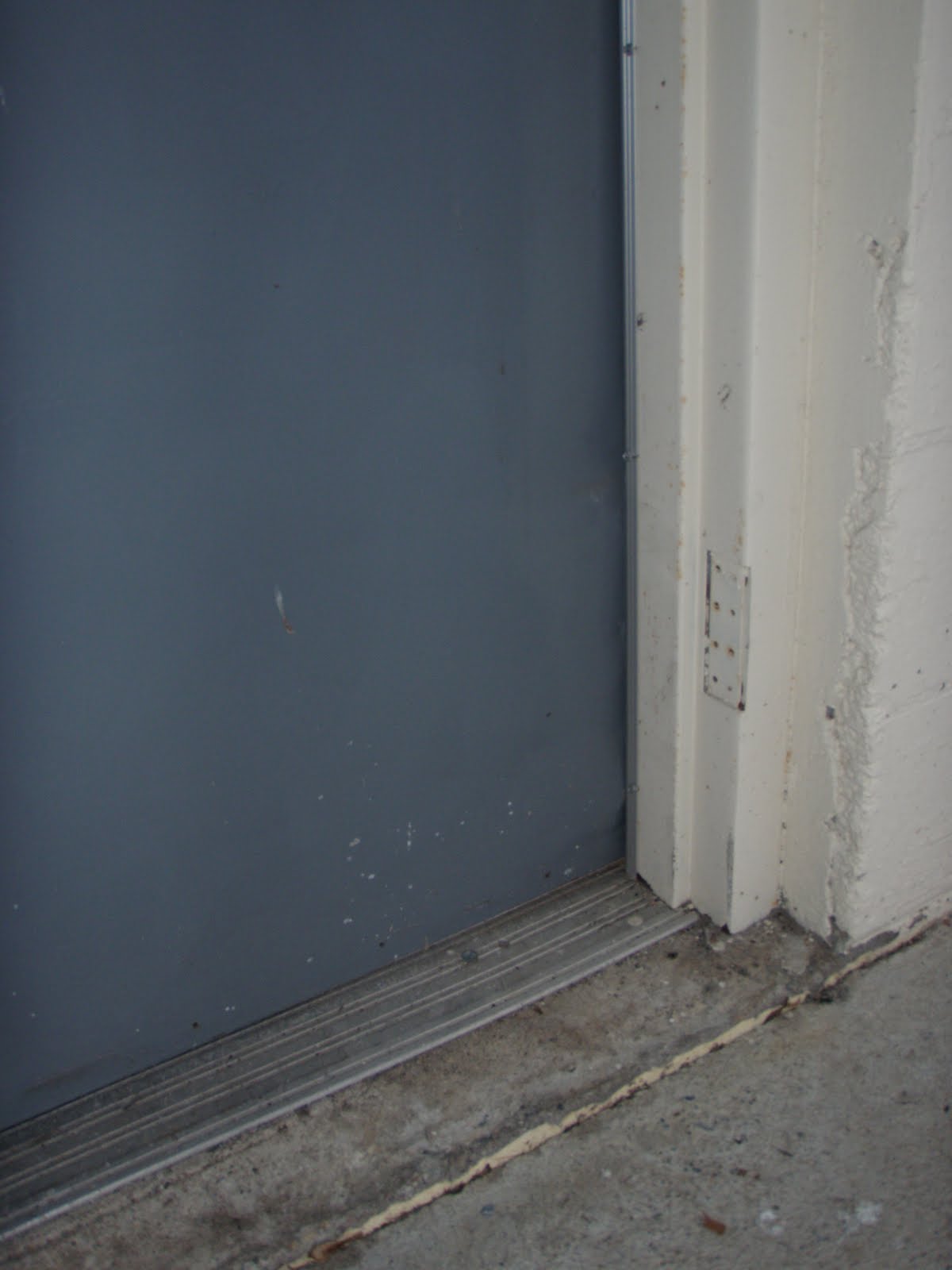
This time of year, even with 12 degree nights and snow on the ground, rodents can be active around structures. Usually, they will exploit and make larger existing openings. A favorite is the opening that may be in between two doors, at the sweep level of an astragal seal. This photo shows a small gap that let enough heat and odors out of it to encourage a rodent to start expanding the opening. You can see a leaf pictured in the gap between where the mouse has chewed it apart. The solution here is to remove these damaged vinyl sweeps and replace them with new, brush style sweeps.
-Lauren Greenhow, General Manager, GreenHow, Inc.
GreenHow.com. Effective Organic & Low Impact Solutions, Lawn Care, Pest Control & Termite Control in Newton and Metro Boston.
Wednesday, March 31, 2010
Water Issues
Rodent issues can follow flooding. For lower lying urban areas, with rat issues nearby, rising water can force rats from burrows and into nearby homes and businesses. When cleaning up after flooding, try to keep basement and crawl space windows and doors closed as much as possible.
-Lauren Greenhow, General Manager, GreenHow, Inc.
www.GreenHow.com. Effective Organic & Low Impact Solutions, Lawn Care, Pest Control & Termite Control in Newton and Metro Boston.
-Lauren Greenhow, General Manager, GreenHow, Inc.
www.GreenHow.com. Effective Organic & Low Impact Solutions, Lawn Care, Pest Control & Termite Control in Newton and Metro Boston.
Wednesday, February 17, 2010
Rats, Again
Boston area rats have been a little more prevalent in residential areas. Making sure that the sewer lines that enter the home have concrete or gravel around the pipe's entry point. Rats need an entry hole the size of a quarter and like to burrow in dirt. Gravel and / or cement will reduce the ability of rats to burrow.
-Lauren Greenhow, General Manager, GreenHow, Inc.
www.GreenHow.com. Effective Organic & Low Impact Solutions, Lawn Care, Pest Control & Termite Control in Newton and Metro Boston.
-Lauren Greenhow, General Manager, GreenHow, Inc.
www.GreenHow.com. Effective Organic & Low Impact Solutions, Lawn Care, Pest Control & Termite Control in Newton and Metro Boston.
Sunday, February 14, 2010
Site Sanitation
Pest control is sanitation. Effective pest control, whether structural pest control, or ornamentals and shrubs is based on site sanitation. Keeping debris properly disposed of will dramatically reduce and control pest populations. For exterior pest control, including reducing issues that affect plant health, clean up all limbs, leaves and debris. Site sanitation will reduce the chance of plant disease. In addition, debris that are cleaned up reduce harborages for other pests, both rodents and insects that if left unchecked may multiply and cause problems inside.
-Lauren Greenhow, General Manager, GreenHow, Inc.
www.GreenHow.com. Effective Organic & Low Impact Solutions, Lawn Care, Pest Control & Termite Control in Newton and Metro Boston.
-Lauren Greenhow, General Manager, GreenHow, Inc.
www.GreenHow.com. Effective Organic & Low Impact Solutions, Lawn Care, Pest Control & Termite Control in Newton and Metro Boston.
Friday, January 15, 2010
Rodents
Urban rodents, such as rats and mice, often seem more prevalent in the winter. Colder temperatures, fewer outdoor resources and other factors cause rodents to end up in our spaces. Within the 128 belt, rats are found even in nice homes in nice neighborhoods, as they will simply follow septic lines into a structure. Effective pest control depends on managing contributing factors. Minimize food and water, and clutter that acts as a harborage to reduce the chances of rodents setting up home in your home.
-Lauren Greenhow, General Manager, GreenHow, Inc.
www.GreenHow.com. Effective Organic & Low Impact Solutions, Lawn Care, Pest Control & Termite Control in Newton and Metro Boston.
-Lauren Greenhow, General Manager, GreenHow, Inc.
www.GreenHow.com. Effective Organic & Low Impact Solutions, Lawn Care, Pest Control & Termite Control in Newton and Metro Boston.
Tuesday, December 29, 2009
The Importance of Sanitation
For control of many structural pests, and turf and ornamental pests and diseases, site sanitation is critical to success. Integrated pest management (IPM) depends on non chemical solutions to alleviate pest issues. One of the most important is site sanitation. For interior sanitation, this time of year can provide a great opportunity for homes and businesses to clear out the cobwebs and improve the level of sanitation. Sanitation usually means implementing proper disposal of waste, but should be expanded to include reduction of clutter, here is a list of ideas on sanitation from the EPA website. An unorganized area, that is inaccessible to you, probably would be a great harborage for insects and rodents. Stored items should be off the ground and away from walls (12 inches is ideal) if possible.
-Lauren Greenhow, General Manager, GreenHow, Inc.
www.GreenHow.com Effective Organic & Low Impact Solutions, Lawn Care, Pest Control & Termite Control in Newton and Metro Boston.
-Lauren Greenhow, General Manager, GreenHow, Inc.
www.GreenHow.com Effective Organic & Low Impact Solutions, Lawn Care, Pest Control & Termite Control in Newton and Metro Boston.
Monday, November 23, 2009
Brush Weatherseals and Pest Exclusion

This is the time of year that we notice an increase in rodent calls. Sealing openings to the exterior is the first solution step in integrated pest management for rodent control. Homes and business usually have numerous small openings around plumbing and electrical penetrations, or where foundation and sill changes occur. The largest openings most homes have are around and under the exterior doors and garage doors. Many options exist to seal them, the most effective is brush weatherseal. We install brush weatherseal door sweeps to keep rodents from entering below a door. We also use brush weatherseals around doors and garage doors, and if necessary, replace the base compression seals below the garage doors. Installing a sweep is a simple operation, measure, select the appropriate brush weatherseal, cut and install. Brush weatherseal is superior to vinyl because it forms a seal up to 3 times tighter and lasts much longer. These photos show a door before and after having brush weatherseals and brush door sweeps installed. For do it yourself customers, consider the Sealeze brand brush weatherseal for superior performance.
-Lauren Greenhow, General Manager, GreenHow, Inc.
www.GreenHow.com. Effective Organic & Low Impact Solutions, Lawn Care, Pest Control & Termite Control in Newton and Metro Boston.
Monday, September 14, 2009
Fall Pests
Fall brings rodents coming back in during cooler weather and longer nights. Inspect the outside of garage and basement doors for worn seals and replace or repair. Exclusion is the single most effective tool in combating rodent infestations and the foundation of an integrated pest management plan for mice.
-Lauren Greenhow, General Manager, GreenHow, Inc.
www.GreenHow.com. Effective Organic & Low Impact Solutions, Lawn Care, Pest Control & Termite Control in Newton and Metro Boston.
-Lauren Greenhow, General Manager, GreenHow, Inc.
www.GreenHow.com. Effective Organic & Low Impact Solutions, Lawn Care, Pest Control & Termite Control in Newton and Metro Boston.
Wednesday, January 21, 2009
Can I compost in the winter?
One customer asked me today, Can I compost in the winter? If you have the Earth Machine composter we have given out to Organic Lawn Care customers in the past, you can add material to the composter. Use your countertop container to collect your materials, such as egg shells and fruit and vegetable material and coffee grounds to limit your trips out in inclement weather. Add shredded newspaper or cardboard for your "brown" since your leaf resource is probably under cover of snow or ice. You are cold composting anyway with such a small pile, and in this weather no breakdown will occur, but keep up with adding matter to the pile. Make sure you return the cover tightly to keep out rodents. You do not want to start a rodent or wildlife issue requiring additional pest control service. For further tips, check out this Winter Composting Fact Sheet from Cornell.
-Lauren Greenhow, General Manager, GreenHow, Inc.
www.GreenHow.com. Effective Organic & Low Impact Solutions, Lawn Care, Pest Control & Termite Control in Newton and Metro Boston.
-Lauren Greenhow, General Manager, GreenHow, Inc.
www.GreenHow.com. Effective Organic & Low Impact Solutions, Lawn Care, Pest Control & Termite Control in Newton and Metro Boston.
Subscribe to:
Posts (Atom)


 Posts

